
Almost nobody comes to Santorini to walk, which is precisely why walking here is so good. The caldera path from Fira to Oia is one of the finest coastal trails in the Mediterranean and it is empty at seven in the morning. The volcano crater is a thirty-minute climb that puts you on active geology. Ancient Thera sits on a ridge 350 metres above two beaches and sees a fraction of Akrotiri’s visitors.
This guide covers the island on foot: which trails are worth doing, how hard each is, when to start, what the heat and wind actually do to a walk here, and how hiking fits alongside vehicle-based santorini tours.
For travellers planning the island, santorini tours and santorini tours offer expertly guided experiences across Santorini — from caldera sunsets and volcano walks to private wine tastings and tailor-made sightseeing.
Do Santorini Tours Include Any Walking?
Every stop involves it — four to six kilometres across a full day, almost all on stone.
On santorini tours the distances between stops are driven, but each village is walked. Oia’s main lane is roughly a kilometre end to end. Pyrgos climbs steadily to its castle. Akrotiri is a level hour indoors. Add the Ammoudi steps and the total rises sharply.
None of it is difficult for anyone reasonably mobile, but it accumulates, and visitors routinely underestimate it because the map makes the island look tiny. Standard santorini tours are not strenuous, but they are not sedentary either.
What Is The Caldera Path On Santorini Tours?
Ten kilometres along the top of the cliff, three to four hours, with continuous views into the crater the entire way.
On walking santorini tours the route runs north from Fira through Firostefani and Imerovigli on paved rim walkways, climbs behind Skaros onto open volcanic hillside, crosses the exposed middle section, and drops into Oia past the windmills.
It is not technical — no scrambling, no exposure to speak of — but it is undulating, completely shadeless and considerably harder in heat than the distance suggests. It is the single best thing to do on foot on the island, and it costs nothing.
How Hard Is The Caldera Path On Santorini Tours?
Moderate in April or October, genuinely demanding in July and August.
On santorini tours the paved section from Fira to Imerovigli is easy walking on a made path, about forty minutes, suitable for anyone. Past Imerovigli the surface becomes dirt and loose rock, the climbs are steady rather than steep, and there is no water, no shade and no facilities until Oia.
In midsummer it becomes a dawn activity or nothing. Every year people attempt it at eleven with a small bottle of water and regret it. Operators running santorini tours will arrange a one-way transfer for the return, which is how most walkers do it.
When Should Walking Santorini Tours Start?
Sunrise, between April and October. Any time in winter.
On santorini tours a six-thirty start in June puts you across the exposed middle section before the heat arrives and into Oia by ten, while the village is still quiet. The same walk begun at ten is three hours in full sun with the arrival timed for the busiest part of the day.
Read more: Thirasia Santorini Private Guided Transfers
The light is also better early — low sun rakes across the caldera wall and picks out the banded rock layers that flatten to grey by midday. Photography-minded santorini tours schedule around exactly this.
How Do You Get Back From Oia?
Bus, pre-booked transfer, or a tour that collects you.
Without santorini tours the KTEL bus runs from Oia to Fira every twenty to thirty minutes in season for a couple of euros. It is the simplest option and works well at mid-morning when the return traffic is light.
A pre-booked one-way transfer costs €25–€40 and is worth it if the timing is tight or the group is tired. Several operators bundle the walk with a pickup and a stop somewhere for lunch, which turns it into a half-day outing rather than a logistics problem.
What Is The Skaros Rock Walk On Santorini Tours?
A fifteen-minute descent from Imerovigli onto a volcanic promontory, and the most dramatic short walk on the island.
Skaros held Santorini’s medieval capital until earthquakes made it untenable. The path drops from Imerovigli onto the saddle, and a rougher continuation leads round to the small chapel of Theoskepasti on the far side, with the caldera on three sides throughout.
Allow forty-five minutes to an hour for the round trip, longer if you go to the chapel. It is steep in places and the surface is loose, so proper shoes matter. Shared santorini tours rarely allow the time; on a private day it is an easy addition to an Imerovigli stop.
What Is The Volcano Walk On Santorini Tours Like?
Thirty minutes uphill on loose black gravel to the crater rim of Nea Kameni, with no shade at all.
On boat santorini tours the vessels land in the middle of the caldera and the path climbs steadily to a viewpoint above the main vent, which still vents steam. The landscape is grey, lunar and genuinely strange, and the villages on the rim become visible for what they are — houses on the edge of an active volcano.
Closed shoes are essential; the gravel is sharp and loose. In July and August the black rock radiates heat and the climb is hard work. It appears on nearly all volcano santorini tours paired with the hot springs.
Can You Walk To Ancient Thera?
Yes, from Kamari or Perissa — about an hour up a steep path, or drive the switchback road.
Read more: Santorini Tours Near Me
Above the beaches on santorini tours, Ancient Thera occupies the spine of Mesa Vouno at 350 metres, with Kamari on one side and Perissa on the other. The Greek and Roman city is exposed rather than buried, so the agora, theatre, temples and houses are all traceable in the stone.
The walk up from Kamari is unshaded and steep and should be done at dawn. Most people drive. Very few santorini tours include the site at all, which is precisely why it is quiet.
Are There Other Trails Beyond Santorini Tours?
Several, though the caldera path is the only one that is well waymarked and busy.
Beyond santorini tours, routes exist from Pyrgos up to Profitis Ilias, from Megalochori toward the south coast, and along stretches of the eastern farmland between the villages. Signage is inconsistent and some sections cross private land or fade out entirely.
They are worth doing with a GPS track rather than by following markers. For anyone wanting a guided version, a few operators run walking-focused santorini tours through the vineyards and inland villages, which is a completely different experience from the rim.
What Is The Profitis Ilias Walk?
A steady climb from Pyrgos to the island’s highest point at 567 metres, about an hour each way.
On santorini tours the summit holds an eighteenth-century monastery and the widest view on Santorini — the caldera, both coasts, the airport, the farmland and the surrounding islands, all at once. It is the only place that shows the shape of the whole island.
The path from Pyrgos is straightforward but exposed. Most visitors drive up, and santorini tours ending there for sunset get the panorama without the effort. For walkers it pairs well with a Pyrgos village stop.
What Should You Wear On Walking Santorini Tours?
Closed shoes with grip, a hat that stays on in wind, and more water than feels necessary.
On santorini tours the village lanes are polished marble worn smooth by decades of foot traffic and genuinely slippery in smooth soles. The volcano path is loose gravel. The caldera trail is dirt and rock. Sandals are wrong for all three.
Read more: Santorini Tours Day Tours
Two litres of water per person on a full walk is not excessive, because there is no source between Imerovigli and Oia. The meltemi will take an unsecured hat off the cliff. Guides on santorini tours repeat this constantly and it remains the most ignored advice on the island.
Is There Any Shade On Santorini Tours Trails?
None. The island has almost no trees.
For santorini tours the aridity means no pine groves, no natural canopy and very little vegetation of any height. The caldera path, the volcano climb and the Ancient Thera ascent are all fully exposed from start to finish.
This single fact governs every walking decision here. It is why the start time matters more than the fitness, and why walking-focused santorini tours run at dawn rather than mid-morning.
When Is The Best Season For Walking Santorini Tours?
March to May and October to November — cool, clear and green in spring.
For walking santorini tours spring is the best of it: wildflowers across the volcanic slopes, temperatures in the high teens, and a clarity in the air that summer haze removes. Autumn is warmer and drier but equally comfortable for walking once October arrives.
Midsummer restricts everything to the first two hours after sunrise. Winter is genuinely pleasant for walking — empty trails, dramatic light, no heat — though the sea half of the island closes and land-based santorini tours are the only ones running.
Can You Cycle Instead Of Santorini Tours?
Possible but not enjoyable — the roads are narrow, winding and busy with coaches.
Unlike santorini tours, cycling has no dedicated lanes, the main road carries all the island’s traffic, and the gradients from the coast up to the rim are substantial. A few operators rent e-bikes, which handle the climbs and are a reasonable option in the shoulder seasons.
Mountain biking on the farmland tracks in the east is more rewarding than road cycling, and considerably safer. It does not appear on any conventional santorini tours.
Read more: Palia Kameni Santorini Private Guided Transfers
Is Horse Riding Available?
Yes, mostly on the southern coast and the inland tracks, in the cooler hours.
Alongside santorini tours, several stables run guided rides of one to two hours across the volcanic farmland and down to the beaches, generally at sunrise or in the late afternoon. It is a genuinely good way to see the agricultural interior that vehicle-based itineraries skip.
Rides suit beginners as well as experienced riders and are usually booked directly rather than through the operators running standard santorini tours.
What About Kayaking Alongside Santorini Tours?
Sea kayaking along the caldera wall is the standout, and almost nobody does it.
Unlike vehicle santorini tours, paddling below three hundred metres of banded cliff is a perspective neither the rim nor a catamaran provides — you are at water level with the whole geological record rising directly above you. Trips run from the old port and from the south coast.
Snorkelling is moderate: excellent visibility, thin marine life. Diving centres operate from Kamari and Perissa. None of this appears on standard santorini tours, which are sightseeing itineraries rather than activity ones.
How Do You Combine Walking With A Tour Day?
Walk at dawn, tour from mid-morning.
Walking and santorini tours fit together because they want different hours. The caldera path is best between six and ten; the archaeological sites and wineries work from eleven onward. A morning walk from Fira to Imerovigli followed by a vehicle pickup is entirely practical.
Operators running private santorini tours arrange exactly this, and it produces a fuller day than either alone. The shared format cannot accommodate it, since the pickup is at a fixed point and time.
Are Walking Santorini Tours Suitable For Families?
The paved Fira to Imerovigli section yes; the rest no.
On family santorini tours that forty-minute stretch is level, made-up and safe, with cafés along the way and views the entire distance. Beyond Imerovigli the surface deteriorates and the exposure and heat make it unsuitable for young children.
Read more: Food Fun Santorini Guided Tours
The volcano climb is manageable for older children who cope with heat and loose ground, and it is usually the part of a boat day they remember. Family-focused santorini tours weight toward the paved sections and the boat rather than the trails.
What Are The Real Risks On Santorini Tours?
Heat exhaustion, dehydration and the wrong footwear — not the terrain.
Nothing on santorini tours is technically dangerous. What sends people to the pharmacy every summer is starting a shadeless ten-kilometre walk at eleven in the morning with half a litre of water, or descending polished marble steps in smooth-soled sandals.
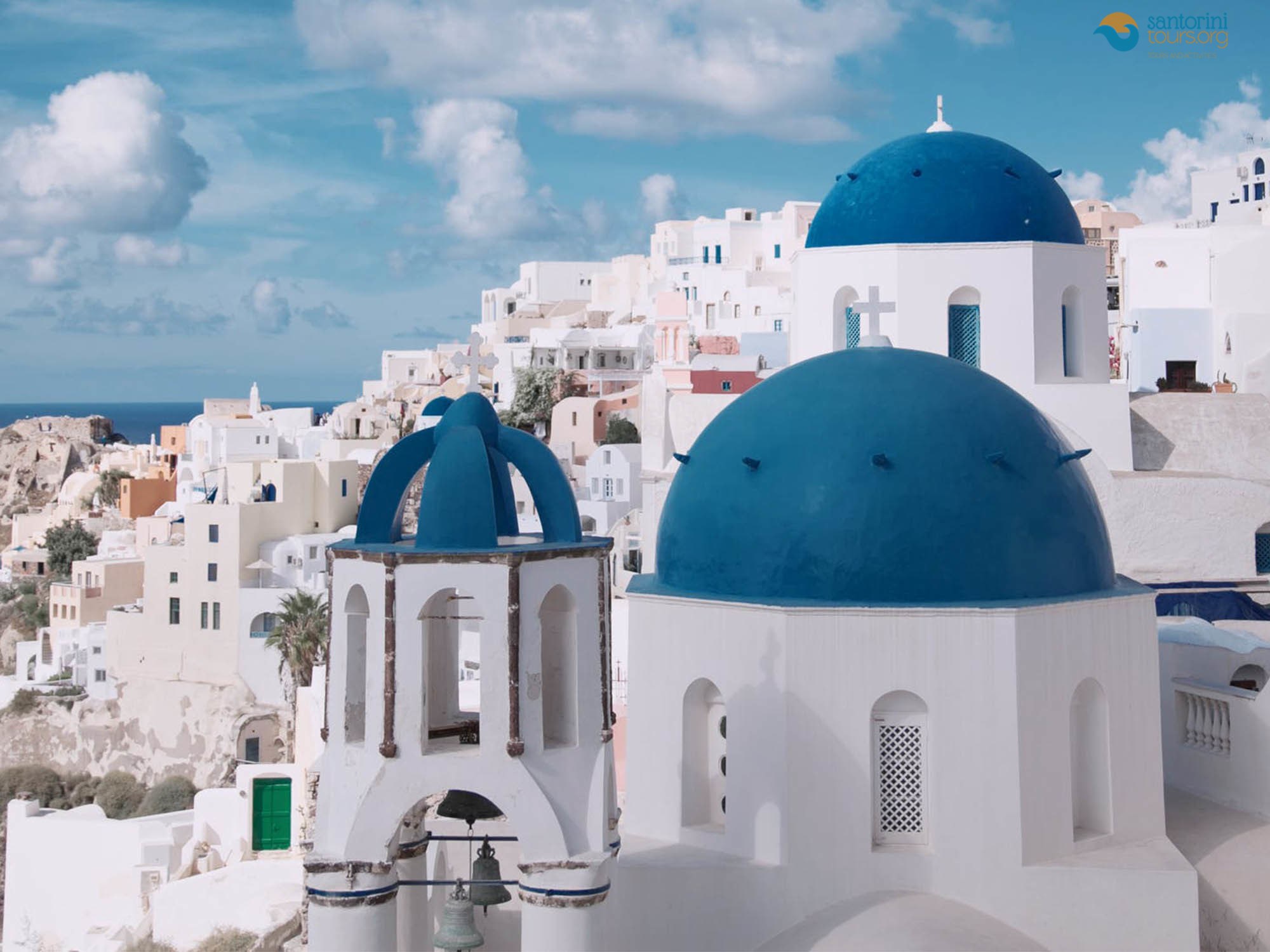
Santorini from the air: the caldera, the villages and the cliffs.
Sunburn is the third. The whitewashed walls reflect light from every direction and burn people who thought they were in shade. Every guide on santorini tours mentions it, and it remains the most common complaint of the season.
What Do You Actually See On The Caldera Path?
The entire inner face of a collapsed volcano, continuously, for three hours.
On walking santorini tours the route begins on the paved rim above Fira with the cliff dropping 300 metres to the water on your left and the villages stacked along the edge ahead. Firostefani brings the Three Bells church into view below the path, and Imerovigli opens onto the widest sweep of the crater with Skaros Rock jutting out beneath.
Past Imerovigli the character changes completely. The paving ends, the villages stop, and the route crosses open volcanic hillside where the only things in view are the cliff, the sea and the islands in the middle of the caldera. This is the section nobody photographs and the one that stays with people.
The final descent into Oia passes the windmills and the castle ruin. Arriving on foot after three hours of empty hillside is a genuinely different experience of the village from stepping out of a vehicle, and it is what walking santorini tours are built around.
How Fit Do You Need To Be For Walking Santorini Tours?
Reasonably, but the limiting factor is heat tolerance rather than fitness.
On walking santorini tours there is no technical difficulty and no serious ascent — the cumulative climb across the whole route is modest, spread over undulating ground. Anyone who walks regularly will manage it comfortably in cool conditions.
Read more: Popular Destination Santorini Private Tour
What defeats people is the combination of full sun, no shade, no water source and reflected heat from pale volcanic ground. A fit walker starting at eleven in July will struggle far more than an unfit one starting at six in April.
The practical test is whether you would happily walk ten kilometres at home. If yes, the caldera path is well within range provided the timing is right, and it is far more rewarding than a third day of vehicle-based santorini tours.
What Is The Terrain Like On Walking Santorini Tours?
Paved for the first third, then dirt, loose volcanic gravel and stretches of bare rock.
On santorini tours Fira to Imerovigli is a made-up walkway with railings in places, suitable for anyone. After that the path narrows to a trodden line across the hillside, with sections of loose scree on the descents and slabs of bare rock where the soil has eroded away.
Nothing requires hands, but the footing is unreliable enough that trail shoes or trainers with real grip are the difference between comfortable and cautious. The polished marble in the villages at either end is slippery in a different way, and the same shoes handle both.
Is The Path Safe Near The Cliff Edge?
Yes — the route stays back from the drop almost everywhere.
On santorini tours the paved section has railings where the exposure is real. Beyond Imerovigli the trail runs along the hillside rather than the lip, and there are very few points where a slip would carry any consequence beyond a graze.
The exception is wind. The meltemi blows hard from the north through midsummer and can be genuinely unbalancing on the exposed middle section. On a strong meltemi day the walk is better postponed, and any driver on private santorini tours will say so honestly if asked.
Can You Walk Between The Other Villages?
Yes, on the eastern farmland tracks — quiet, flat and almost entirely unvisited.
Away from santorini tours, Pyrgos to Megalochori, Megalochori toward Emporio, and the lanes through the vineyard belt are all walkable on a mixture of small roads and farm tracks. The going is easy, the gradients gentle, and the surroundings are the working island rather than the postcard.
The basket-trained vines are the visual reward — fields of low grey coils on pale ash, which look like nothing else in European agriculture. Waymarking is inconsistent, so a GPS track helps. These routes appear on almost no santorini tours, which is exactly why they are empty.
Read more: Santorini North Part Tour
Frequently Asked Questions About Walking
How Long Is The Fira To Oia Walk Really?
About ten kilometres, three to four hours at a comfortable pace with photo stops. Faster walkers do it in two and a half.
Can You Do It In Reverse?
Yes, and Oia to Fira has the sun behind you in the morning. Most people walk north because arriving in Oia feels like a destination.
Is There Water On The Route?
Only at Imerovigli, about a third of the way. Nothing between there and Oia.
Do You Need A Guide?
No — the caldera path is obvious and well trodden. Guided walking santorini tours add context rather than navigation.
What Is The Best Short Walk?
Fira to Firostefani to Imerovigli, forty minutes each way on paved path. It delivers the island’s best views for no effort.
Are The Trails Marked?
The caldera path yes, the inland routes inconsistently. Carry a GPS track for anything off the rim.
How Does Walking Change What You Understand About The Island?
It makes the geology legible in a way no viewpoint does.
On vehicle santorini tours the caldera is a series of framed views. On foot it is continuous, and the banded layers in the cliff — black basaltic lava, red oxidised scoria, the thick white band of Minoan ash near the top — resolve into a sequence of eruptions rather than decoration.
The same applies to the land behind the rim. Walking through the vineyard belt shows how thin the soil is, how widely the vines are spaced to catch night moisture, and how completely the island’s agriculture is shaped by having no water. None of that registers at forty kilometres an hour.
This is the strongest argument for adding a morning on foot to a stay otherwise built around santorini tours. The vehicle days deliver the places; the walk delivers the reason they look the way they do.
Read more: Santorini Private Custom Tour
What Should You Carry On A Long Walk?
Two litres of water each, sun protection, a wind layer, snacks and a phone with a charged battery.
On walking santorini tours water is the one that matters. There is no source between Imerovigli and Oia, no taverna, no tap, and the walk takes three hours in dry heat. Buying large bottles at a supermarket beforehand costs a fraction of the beach-kiosk price.
Sun protection means high factor, a hat that stays on in wind, and sunglasses — the pale ground reflects light upward as well as down. A light windproof matters more than it sounds, because the exposed middle section is markedly cooler than Fira when the meltemi is running.
Take a power bank if the phone is also the map and the return-transfer confirmation, which on a self-guided walk between santorini tours it usually is.
Are There Guided Walking Tours?
A handful, and they are worth it for the inland routes rather than the caldera path.
Unlike most santorini tours, the Fira to Oia trail needs no guide — it is obvious, well trodden and impossible to lose. What a guide adds there is context: the geology, the abandoned settlements, the history of Skaros, which is genuinely interesting but not navigational.
The inland and vineyard routes are the opposite. Waymarking is poor, several sections cross farmland, and knowing which tracks connect is the whole difficulty. Guided walking santorini tours through the eastern villages solve a real problem and cover ground almost no visitor sees.
What Is The Best Half-Day Walk On Santorini Tours?
Fira to Imerovigli and back, with the Skaros descent in the middle.
The paved rim path from Fira through Firostefani to Imerovigli takes about forty minutes each way on made-up walkway with railings, cafés along the route and the caldera in view the entire distance. Adding Skaros turns it into a proper half day without adding any real difficulty.
It is the option for anyone who does not want to commit to the full ten kilometres to Oia, and it delivers a large share of the same views. Because it starts and finishes in Fira there is no transport to arrange at all, which makes it the ideal free-day activity between booked santorini tours.
Read more: Santorini Sightseeing Tour
Early morning or the two hours before sunset are the right windows. In midsummer the middle of the day on that path is uncomfortable rather than dangerous.
Can You Walk From The Cruise Port?
Only up the 588 steps, and it is a poor idea with a sailing deadline.
The old port sits at the foot of a 300-metre cliff and the stepped donkey path is the only walking route to Fira. It is steep, shared with the animals in both directions and unpleasant in the heat, and it takes most people thirty to forty-five minutes uphill.
Some passengers walk down in the morning to avoid the cable-car queue and ride up on the return, which is a reasonable compromise. Walking both ways on a port day burns time that the schedule does not have, and cruise-focused santorini tours build the cable car into the timing for exactly that reason.
Is Walking A Realistic Alternative To Booking A Tour?
For part of the island, yes — for the rest, no.
The caldera rim is genuinely walkable end to end, and between the rim path and the bus network a determined visitor can reach Oia, Fira, the villages in between and two beaches without booking anything.
What walking cannot reach is Akrotiri with a licensed guide, the wineries, the inland villages, Ancient Thera and the sea. Those need a vehicle, and several of them need someone who can explain what you are looking at.
The sensible combination on a stay of four nights or more is one morning on foot, one day of santorini tours covering the archaeology and the interior, and one boat day. That covers the island properly and costs less than three booked days.
What Is The Wind Like On Santorini Tours?
The meltemi blows hard from the north through midsummer and it dominates every outdoor decision.
It is a dry northerly that can run for days at a stretch, and on the exposed caldera path it is strong enough to be unbalancing rather than merely annoying. Hats go over the cliff, tripods vibrate, and the middle section of the walk becomes genuinely tiring.
On land it is also a relief — it strips the humidity and makes 30°C feel manageable, which is why summer here is more bearable than the temperature suggests. At sea it is the main cause of cancelled sailings between July and September.
Read more: Santorini Full Day Tour
The practical response is to check the forecast the evening before and to have an alternative. Sheltered options exist: the eastern farmland tracks, the Emporio kasteli, the inland villages. Any driver on private santorini tours will know which side of the island is out of the wind on a given day.
Are There Any Facilities On The Trails?
Nothing between Imerovigli and Oia — no water, no toilets, no shade, no shelter.
That seven-kilometre section is the longest stretch on the island without any infrastructure at all. There is no phone signal blackspot, so summoning help is possible, but there is nowhere to buy anything and nowhere to get out of the sun.
Fira, Firostefani, Imerovigli and Oia all have cafés, shops and toilets. The volcano island has none. Ancient Thera has a ticket office and nothing else. Planning around that is the whole of trail preparation here, and it is why guides on santorini tours make the water point so insistently.
What Wildlife And Plants Will You See?
Very little, and that is part of the character.
The island supports low scrub, thyme, caper bushes growing straight out of the rock, and in spring a genuine wildflower display across the volcanic slopes. There are no forests, no rivers and no large mammals. Lizards, goats, seabirds and a great many cats are the fauna.
The absence is the point. Walking here is a landscape experience rather than a nature one — rock, ash, sea and sky, with the geology doing all the work. Spring walkers get the one season when colour appears, which is why March to May is the best window for anyone combining hiking with santorini tours.
The Short Version
Walk Fira to Oia at dawn between March and June or in October, with closed shoes, two litres of water and a bus or transfer arranged for the return. Add Skaros for the drama, Profitis Ilias for the view, and the volcano if you are taking a boat anyway.
The island rewards walking far more than its reputation suggests, and the trails are empty at exactly the hours the villages are not. For anyone spending several days here, one morning on foot is worth more than a third day of vehicle-based santorini tours.
Do Santorini Tours Offer Sunrise Walks?
A few operators do, and it is the best-value outing on the island.
The arrangement is simple: a pickup at around half past five in June, a drop at Fira or Imerovigli, and a collection from Oia three hours later with breakfast somewhere on the way back. The cost is essentially a one-way transfer plus a driver’s early start.
What it buys is the caldera path in the only conditions that make it comfortable in summer, and Oia at the one hour it is genuinely empty. Both are things no midday itinerary can deliver at any price.
Ask specifically when booking, because it is rarely advertised. Operators are generally willing — an early start is easier for them than an evening one, and it frees the rest of their day.
How Do Santorini Tours Handle Walkers Who Want Both?
With a split day: walk in the morning, meet the vehicle at a village, continue by road.
The most common arrangement is a dawn start on the caldera path from Fira, a pickup at Imerovigli or Oia around ten, and then a conventional route south through Akrotiri, a winery and an inland village. It produces a fuller day than either activity alone and costs no more than a standard private booking.
The logic is that walking and driving want opposite hours. The trail is at its best between six and ten, when the archaeological site has not opened and the wineries are not pouring. The vehicle stops work from eleven onward, when the path has become uncomfortably hot.
Shared itineraries cannot accommodate this because the pickup is at a fixed point and time. It is one of the clearer cases where the private format buys something a cheaper booking genuinely cannot.
What Do Walkers Regret Not Doing?
Starting later than planned, and skipping Skaros.
The two regrets are consistent. An hour’s delay in leaving turns a comfortable walk into a hot one, and by the exposed middle section there is no way to undo it. And Skaros is fifteen minutes off the route, takes under an hour in total, and is the most dramatic thing on the whole rim — yet most walkers pass the turning without stopping because Oia is the objective.
Both are easy to fix in advance and impossible to fix afterwards, which is why they are worth raising when arranging santorini tours rather than deciding on the morning.
Can You Walk The Island In A Day?
End to end, yes — roughly 25 kilometres from Oia to Perissa, and almost nobody does it.
The route links the caldera path to the inland farmland tracks and drops to the south coast, taking eight to ten hours with breaks. It is not a marked trail and several sections need a GPS track, but the terrain is straightforward throughout and there is no serious ascent beyond the climb behind Skaros.
The obstacles are heat and water rather than difficulty. It is a March-to-May or October proposition only, needs three litres per person, and should be started at first light. Villages en route at Pyrgos and Megalochori provide the only resupply.
For most visitors it is more ambition than the island warrants — the rewards flatten out after the caldera section. But for anyone who walks seriously, it is a genuine long day on an island nobody associates with hiking at all, and it costs nothing beyond a transfer back at the end.
Is Walking Better In Spring Or Autumn?
Spring for the landscape, autumn for the warmth and the sea.
March to May brings wildflowers across the volcanic slopes, green hillsides that vanish by June, and air clear enough to see the neighbouring islands from Profitis Ilias. Temperatures sit in the high teens, which is close to ideal for a ten-kilometre walk with no shade.
October reverses the trade. The hillsides are brown and the flowers long gone, but the sea is at its warmest of the year and a swim at the end of a walk is genuinely inviting rather than bracing. The light is also softer and longer than in spring.
Either beats midsummer comfortably for anyone combining walking with santorini tours, and both are cheaper and quieter than the peak weeks.
Read More
Discover more from Casinos Lots Greece:
- GDPR
- iGaming SEO Agency Pricing: What It Really Costs and How to Get the Best Value
- Professional Escort SEO Services: Proven Strategies To Dominate Search Rankings
- SEO for Roofing Companies: How to Dominate Local Google Rankings and Double Your Lead Flow
- SEO Marketing for Plumbers: Dominate Local Searches and Boost Leads
Contact
Santorinitours.org
Travel Agency In Greece
Karterados 847 00
6936914687